

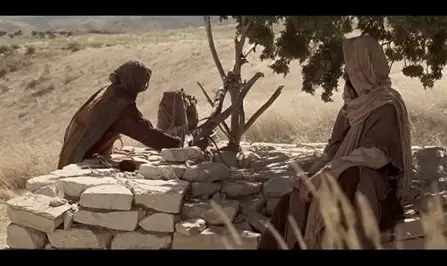
The encounter between Jesus and the Samaritan woman in John 4 may appear on the surface to be an ordinary conversation beside a well. But beneath that moment lies one of the most revealing insights into how God interacts with broken people, how He exposes truth without shaming, and how He draws us away from religious debates into authentic worship.
One detail often overlooked is in John 4:20, when the woman suddenly says:
“Our fathers worshiped in this mountain; and ye say that in Jerusalem is the place where men ought to worship.”
Nothing in Jesus’ previous statements pointed toward a conversation about mountains or worship sites. He didn’t mention tradition, geography, or religious disputes. Yet she brought all of that up.
Why?
That unexpected shift reveals a powerful spiritual reality still true today.
1. When Truth Reaches the Heart, People Often Reach for Religion
Just before her comment about worship places, Jesus had touched the most vulnerable part of her story:
“Thou hast had five husbands; and he whom thou now hast is not thy husband.” (John 4:18)
In that moment, she wasn’t embarrassed; she was exposed.
Conviction landed.
Light entered places she had tried to keep hidden.
And like many people, when the truth becomes personal, she immediately reached for something impersonal: religion.
She moved from:
- her personal reality
→ to a theological argument.
From:
- conviction
→ to distraction.
From:
- “This is about me…”
→ to “Let’s talk about which religion is right.”
Even today, when God presses a sensitive area of the heart, people often respond with:
- “What about other denominations?”
- “Which church is right?”
- “Which doctrine is correct?”
Anything to avoid facing the truth God just revealed.
2. She Used the Biggest Religious Argument to Hide Her Pain
The Jews and Samaritans had one major point of tension:
- Jews said Jerusalem was the rightful place of worship.
- Samaritans insisted on Mount Gerizim.
She pulled this centuries-old conflict into a moment that had nothing to do with locations or traditions. It was a well-crafted distraction.
But Jesus wasn’t fooled.
She wasn’t looking for a debate, she was trying to avoid deliverance.
3. Jesus Refused to Argue Religion – He Gave Revelation
Instead of debating her point, Jesus lifted the conversation to a completely different level:
“The hour cometh, when ye shall neither in this mountain, nor yet at Jerusalem, worship the Father.” (John 4:21)
“God is a Spirit: and they that worship Him must worship in spirit and in truth.” (John 4:24)
With a single answer, He dissolved a 400-year argument.
He essentially said:
- It’s not about the mountain —- it’s about the heart.
- Not about where you worship – but how.
- Not about tradition – but truth.
- Not about geography – but relationship.
He pulled her away from:
- her shame,
- her arguments,
- her religious defenses,
- her old mindset,
and pointed her directly to the Father.
4. The Most Broken Often Become the Boldest Evangelists
What happened next is remarkable.
The woman:
- left her waterpot,
- ran back to the city,
- shared her encounter,
- and drew an entire village to Christ.
She came to the well ashamed.
She left as a messenger.
Her wounded past became a tool of influence.
Her private pain became public testimony.
Her isolation turned into impact.
This is what happens when truth meets the heart in love.
5. The Lesson for Us Today
Many believers still respond the way she did.
When God reaches for their hearts, they hide behind:
- doctrinal questions,
- church arguments,
- denominational debates,
- theological distractions.
But Jesus still calls us higher.
He still says:
- “Stop focusing on mountains — come to Me.”
- “Stop arguing — start worshiping.”
- “Stop hiding — let Me heal you.”
Conclusion
The Samaritan woman didn’t need another religious conversation.
She didn’t need a debate, a seminar, or an argument.
She needed living water.
Jesus met her in her brokenness, revealed truth without condemnation, and transformed her into a witness who changed her entire community.
This story continues to remind us that:
- God meets us where we are,
- speaks truth that frees rather than shames,
- and draws us past religious noise into real worship.
And He is still doing the same today.
Tyson Ibrahim Jacob is the founder of Faith Exercises Ministries and author of the Faith Exercises book. He is also the founder of TMI Life Concerns, a company dedicated to business consulting, life coaching, and empowering individuals to grow personally, professionally, and spiritually.
Based in Washington, USA, Tyson leads Faith Exercises Ministries, a registered organization serving people around the world through messages of faith, purpose, and transformation. As a speaker, pastor, and entrepreneur, Tyson inspires individuals globally to deepen their faith, embrace their purpose, and build lives of lasting impact.